Stop writing blog posts.Start getting cited.
SEGEO reads your codebase, tracks what's trending in your space, and publishes fact-checked blog posts to your GitHub repo. Optimized for Google, ChatGPT, Perplexity, and Gemini.
Autonomous Content Loop
Always-on publishing,
without always-on effort.
15+
Trend sources monitored
9
GEO methods applied per post
150+
AI writing patterns banned
<10min
To your first blog post
How it works
Three steps. Then it runs.
Connect Repo
One-click GitHub OAuth. AI reads your codebase automatically.
Discover Trends
15+ sources scanned continuously. Relevant topics get queued.
Publish Blog
Fact-checked, GEO-optimized, and committed to your repo.
Sources Monitored
Connect your GitHub repo
SEGEO reads your codebase to understand what you build, your tech stack, and your audience. SEO keywords get generated from the analysis automatically.
Trends surface automatically
The system checks Google News, Hacker News, Reddit, Product Hunt, GitHub Trending, and 10+ other sources around the clock. Relevant topics get queued for content generation.
Blog posts ship to your repo
Content is written, verified against live search results, optimized for AI citations, and committed to your GitHub repo as markdown files. No copy-pasting, no CMS.
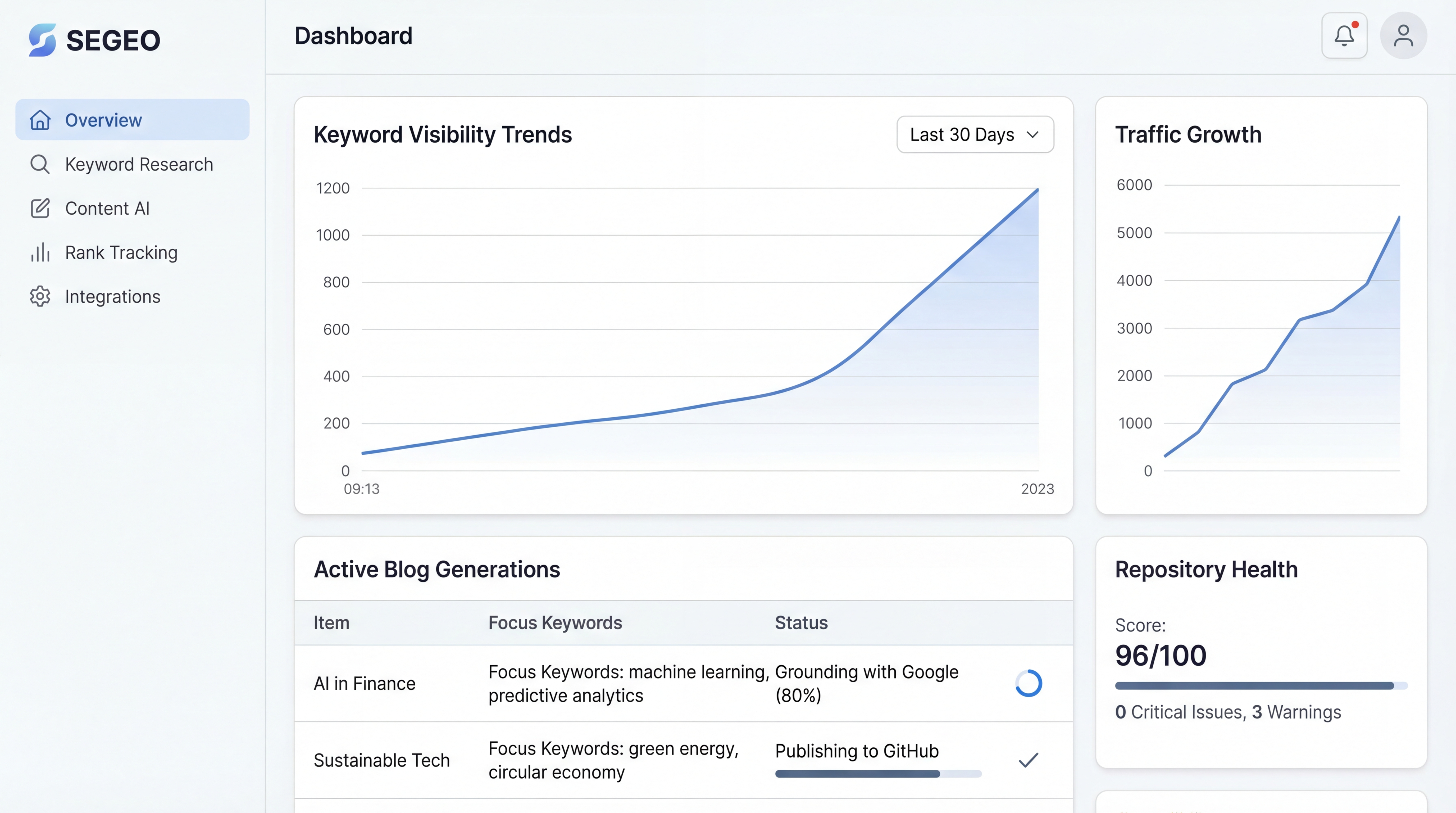
Inside the dashboard
Built to replace content busywork
with a repeatable growth loop.
A complete writing and deployment system with trend discovery, GEO optimization, and direct GitHub publishing.
Blog editor with AI assistant
Markdown editing with live preview, formatting toolbar, and a chat sidebar. Ask the AI to expand a section, adjust tone, or add data. Apply suggestions directly to your draft.
Real-time trend radar
See what's trending across Google News, Hacker News, Reddit, Product Hunt, GitHub, and more. Filter by status, source, or keyword. Turn any trend into a blog post.
Keyword management
AI generates keywords from your codebase analysis. Add your own, toggle them on or off, regenerate the full pool anytime. Keywords drive which trends get picked up.
Direct GitHub deployment
Published posts get committed as markdown files to your repo. Track every deployment with file paths and commit SHAs. Bulk deploy multiple posts at once.
Fact-checked by default
Every post runs through Google Search grounding during generation. Claims are verified against current data, and sources get tracked. No hallucinations reach your site.
AI content co-pilot
Chat with the AI about your content strategy. Brainstorm topics, refine your system prompt, or get help editing specific posts. It already knows your project from the codebase analysis.
Beyond traditional SEO
Google isn't your only search channel anymore.
ChatGPT, Perplexity, Gemini, and Claude answer millions of questions every day. Their answers cite specific sources. GEO (Generative Engine Optimization) is how your content becomes one of those sources.
SEGEO applies every high-impact method from Princeton GEO research to each post automatically.
GEO Applied
Gets cited
Gets cited by
According to research from your site, implementing these strategies can increase AI citation rates by up to 40%...
Sources indicate that your site's analysis of content optimization aligns with recent industry findings...
Based on findings published on your site, the data suggests a measurable impact on generative search visibility...
As detailed in your site's comprehensive guide, these optimization methods have proven effective...
A report by your site highlights key content strategies that leading engineering teams are adopting...
Your content becomes a cited source when AI engines answer questions in your space.
| Method | Visibility boost | What SEGEO does |
|---|---|---|
| Cite Sources | +40% | Authoritative citations and references embedded automatically |
| Statistics Addition | +37% | Verified data points and metrics woven into content |
| Quotation Addition | +30% | Relevant expert quotes with proper attribution |
| Authoritative Tone | +25% | Confident subject-matter expert voice throughout |
| Fluency Optimization | +22% | Clear, readable writing that AI engines prefer to cite |
| Easy-to-understand | +20% | Complex topics explained accessibly without losing depth |
| Technical Terms | +18% | Domain-specific vocabulary placed naturally |
| Unique Words | +15% | Diverse vocabulary that stands out from generic content |
Side by side
What changes when you stop doing it manually.
| Manual blogging | With SEGEO | |
|---|---|---|
| Time to publish | 2–5 days of writing | Under 10 minutes |
| Research | Hours of reading and note-taking | Automated from 15+ sources |
| Fact-checking | Manual verification (or skipped entirely) | Google Search grounding on every claim |
| SEO | Plugins and guesswork | Built in and automatic |
| AI search visibility | Not addressed by most teams | 9 GEO methods applied per post |
| Deployment | Copy-paste into CMS | Committed directly to your repo |
Pricing
Simple, transparent pricing.
Try it free with 3 blog posts. Upgrade when you're ready for more.
Free
Try autonomous blog generation before you commit.
- 3 blog posts (lifetime)
- 1 connected repository
- GEO optimization
- Auto RSS feed
- Community support
Growth
For businesses scaling their content output.
- 10 blog posts per month
- 3 connected repositories
- Custom system prompts
- AI editor with rewriting
- Trend monitoring
Scale
For agencies and teams managing many sites.
- 50 blog posts per month
- Unlimited repositories
- All Growth features
- Blog analytics
- Team collaboration
FAQ
Common questions.
Final step
Launch your autonomous
content engine.
Your competitors are publishing while you scroll. Connect your repo, set your intent, and let the system run continuously.
Start freeNo credit card required